What is it
that makes the classic romance novels so great?
There are very few books I read multiple times. Usually once is enough. Yet I never tire of reading Jane Austen's Pride and Prejudice over and over. What is it that makes a great romance?
Characters
Great
romances have unique, relatable, well-developed characters. Take Pride
and Prejudice's Elizabeth Bennett, for instance. She is far from perfect. She is delightfully quirky and doesn't fit
the mold for the society portrayed in the novel. She is smart, witty, impertinent,
opinionated, and very, very and likable and easy to relate to. Mr. Darcy as well is a very unique, complex
character. What woman reading Pride and Prejudice doesn't put herself
in Elizabeth Bennett's shoes and wish for her own modern day Mr. Darcy?
Conflict
There is no
plot without conflict. But a romance has
either the sole or additional conflict of the relationship between the man and
woman. In some books, the romance is the
entire plot, while in others the romance works in tandem with additional action
and storyline. In short, there has to be
some problem that is keeping the couple apart.
This problem can be internal struggles the characters face, as in Pride and Prejudice or external problems
as in Romeo and Juliet. Elizabeth Bennett and Mr. Darcy aren't
together because of their own pride and prejudices, whereas Romeo and Juliet
are kept apart by their feuding families.
Either way, a great romance requires a great conflict, making the reader
wonder, will they get together or not?
Chemistry
A great
romance requires chemistry between the characters. There must be an attraction, some magic woven
between two people. The reader's heart
needs to pound in time with the main character's. Whether it be love at first sight or the
classic 'I love you, I hate you,' interplay between Elizabeth Bennett and Mr.
Darcy, there has to be fireworks that the reader can feel and relate to. Added to this is the delayed satisfaction
that, because of the conflict in the story, this chemistry is forbidden in some
way. And that is how a reader is hooked.
Climax
By 'climax,'
I refer to the major turning point of the story. Everything has been building to this moment
when the characters either get together or not.
A strong, definite climax is what helps a romance be memorable. A skilled author will draw the reader in so
he or she feels what the character feels at that moment, experiencing the drama
and romance of feelings being declared and the tide turning. The final climactic scene in Pride and Prejudice where Elizabeth and
Mr. Darcy declare their feelings is horribly romantic with him saying, "If your feelings are still what they were last April, tell me so at once. My affections and wishes are unchanged, but one word from you will silence me on this subject for ever." However, I have to
admit, I actually prefer the sheer romance and drama of the same scene
beautifully portrayed in the 2005 movie.
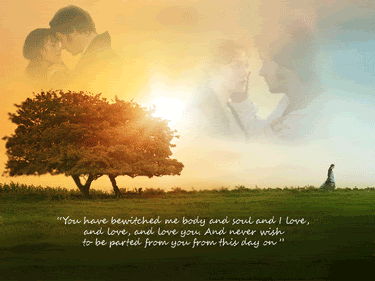
For after everything, what woman's heart doesn't melt at Mr.
Darcy's words as he finally tells Elizabeth, "You have bewitched me body
and soul, and I love, and love, and love you.
And never wish to be parted from you from this day on."
Conclusion
As much as I
hate to admit it, the conclusion, the ending, of a great romance doesn't have
to be happy. But it does have to be
memorable. Part of the great allure of Romeo and Juliet is that it's such a
shocking, tragic end to the star-crossed lovers. Would the romance be as memorable if Romeo
and Juliet had experienced their happily ever after? No, probably not. But each story is individual. Would the romance be as memorable if
Elizabeth and Mr. Darcy hadn't experienced their happily ever after. Absolutely not. Simply put, the conclusion has to match the
story, and it has to be good. I hate it
when a good romance just fizzles at the end with a sappy line, as if the author
doesn't know how to end it. It just kind
of ruins the entire story for me. I'm a
firm believer that the ending, even the last sentence of the book has to echo
and tie off the entire story. It's like
the last flavor in the mouth of the reader.
Make it count.
So, let us
spin the web of romance for our readers.
Let us draw them in to an alternate reality where the characters are
real. Let us make them feel and
imagine. My romances will probably never
rank up with the classics; all I can hope for is to do a little of my own
bewitching.